TL;DR
- Pick an emulator with a licence you can fork if the terms change. Floci, Ministack and kumo are MIT, and AWS Emulator is CC0. fakecloud is AGPL-3.0, so ask your legal team first. LocalStack's free edition ended on 23 March 2026.
- For Python tests or a Serverless Framework project, a smaller tool is enough: Moto for Python, serverless-offline for Lambda and API Gateway.
- For many services behind one endpoint, with no account and no token, Floci is the one we run, and Ministack is the fallback we named. AWS Emulator went GA on 11 November 2026. It is free, public domain and days old, so read its scores as a moving number.
- A green local test shows that the emulator agreed with your code. Keep a test against real AWS for the behaviour that matters.
For years, running AWS on your laptop had one answer. You started LocalStack on port 4566, pointed the SDK at it and wrote your tests. In 2026 that answer changed, and the choice is open again. This post maps the options and their limits, with the source of each fact.
We used LocalStack for years. In one of our projects Floci is now the default emulator, and DynamoDB Local is the second tool for table behaviour. We have not run the other tools on our own workloads. For those, the facts come from their repositories and documentation, and the post says so.
What changed in 2026
On 23 March 2026, LocalStack release 2026.03.0 moved the free community edition into the paid product. The container needs an account and an auth token, also in CI. The free Hobby plan is for non-commercial use, and commercial use is from $39 per licence per month, billed yearly. That price comes from a third party, AgentDeals, so check LocalStack's own pricing page before you plan around it. The repository localstack/localstack is archived, with its last push on 23 March (GitHub API, 16 November 2026). A team that weighs the move should count three costs: the licence seats, the token in every CI job and the work to move its test suites.
Several free emulators were already starting. kumo was created on 3 February 2026, Floci on 18 February, Ministack on 24 March and fakecloud on 4 April (GitHub creation dates). On 11 November AWS added its own, AWS Emulator, generally available and with no service fee. In a few months one default became six full emulators.
The options at a glance
The options sit in three layers. A full emulator is a server with one endpoint for many services. A mock library runs inside your test process. A single service tool covers one service or one framework.
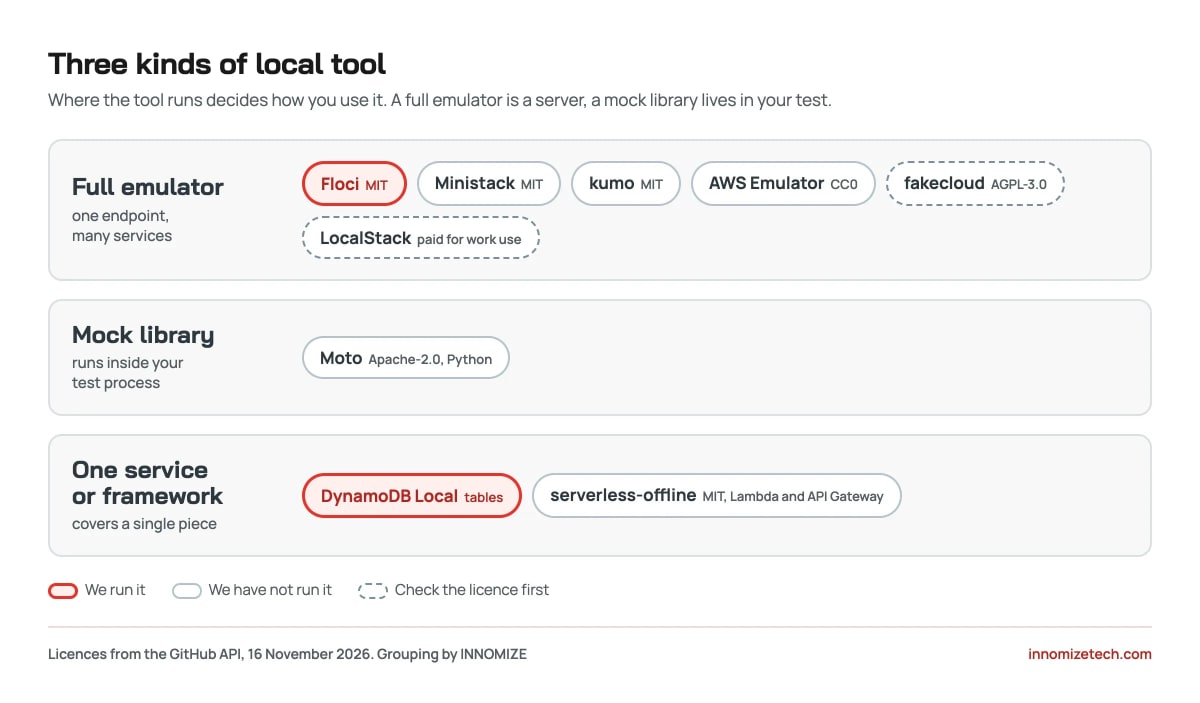
| Tool | Layer | Licence | How it runs Lambda | Our stance |
|---|
| Moto | Mock library | Apache-2.0 | Not checked | Not used. It is a Python library and our tests are Node.js |
| serverless-offline | One framework | MIT | Runs your handlers locally, for the Serverless Framework | Not used |
| DynamoDB Local | One service | Not checked | Not applicable | Second tool, for table behaviour |
| Floci | Full emulator | MIT | Real containers, through the Docker socket | Default in one project |
| Ministack | Full emulator | MIT | Containers, through the Docker socket (README) | Named as fallback, not run |
| kumo | Full emulator | MIT | Listed as a service, method not checked | Not used |
| fakecloud | Full emulator | AGPL-3.0 | Real containers, Docker by default (README) | Not used |
| AWS Emulator | Full emulator | CC0 1.0 | Not checked by us | Looked at, not in use |
| LocalStack | Full emulator | Paid for work use | Containers | Used for years, not since March |
Floci, Ministack, kumo and fakecloud all list port 4566 in their READMEs, the port LocalStack used, so a first trial can change only the endpoint. AWS Emulator listens on 127.0.0.1:9297. Every repository except serverless-offline (last push 19 October) and LocalStack (archived) had a push in the three days before 16 November.
Full emulators: one endpoint, many services
Floci
The first trial of Floci taught us the most, and for a reason we did not plan. We set two values by hand and got both wrong, a relay timeout and the target of an event source mapping. The trial also found a handler string that the runtime could not load, and no unit test had seen it. We now build the emulator setup from the synthesized stack templates, so it cannot drift from them unseen.
Floci is MIT licensed and needs no account and no token. Its README compares it with LocalStack at about 24 ms startup, about 13 MiB idle memory and about a 90 MB image. Those are the vendor's numbers, and we did not measure them. It runs Lambda, RDS, ElastiCache, MSK and ECS in real Docker containers. On Floci 2.3.0 (released 15 October) the first trial started in 0.089 seconds on one machine. On 4 and 5 November we ran a whole event flow with the real bundles: bus, rule, queue with a dead-letter queue, table stream, Lambda on nodejs24.x, versions, aliases, function URLs and both kinds of event source mapping. All of it passed. One limit comes with it. Lambda runs only through the Docker socket, and the first run pulls an image of about 611 MB.
Ministack, kumo and fakecloud
Ministack has 60+ services on one port. Its README, read on 23 October, says RDS starts a real Postgres or MySQL, ElastiCache starts real Redis or Valkey, and a local Bedrock proxy sends calls to Ollama or vLLM, and it claims under 2 seconds startup, about 30 MB idle memory and about a 270 MB image. Those are vendor numbers, and we did not re-read them for this post. We named it as the fallback for a service Floci lacks, and we have not needed it yet.
kumo is a small emulator in Go. Its README lists Lambda and Step Functions among its services and offers optional data persistence with KUMO_DATA_DIR. It also lists EventBridge and SQS, and we did not check how it connects them to functions. fakecloud claims 107 services and 7,729 operations in its GitHub description, which we did not check. Its README says SigV4 verification and IAM enforcement are opt in and off by default. The AGPL-3.0 licence can affect company use, so ask your legal team before it goes on a build machine.
AWS Emulator
AWS Emulator is written in Rust and built from the 438 API models AWS publishes. The SDK and CLI point at it with environment variables. Everything is in memory, so state is gone when it stops. It serves one account and one Region per emulator, and an operation it does not implement returns HTTP 501. On macOS and Windows you build a Docker image from a Dockerfile in the docs, because AWS publishes no ready-made image.
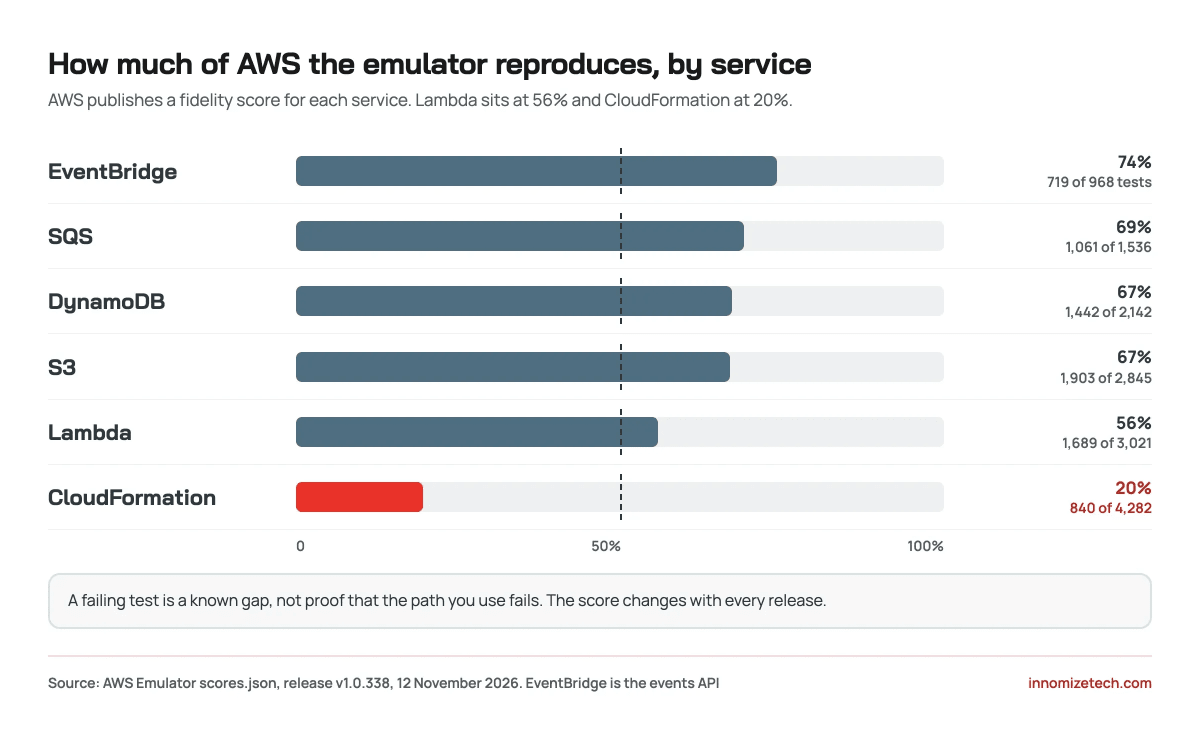
AWS publishes a fidelity score per service with each release, as tests passed out of tests run. These figures cover services a typical serverless app uses. They come from release v1.0.338 of 12 November 2026, and each share is passed divided by total.
| Service | Passed | Total | Share |
|---|
| EventBridge (events API) | 719 | 968 | 74% |
| SQS | 1,061 | 1,536 | 69% |
| DynamoDB | 1,442 | 2,142 | 67% |
| S3 | 1,903 | 2,845 | 67% |
| Lambda | 1,689 | 3,021 | 56% |
| CloudFormation | 840 | 4,282 | 20% |
In that release 26,001 of 43,548 tests passed, about 60%, and 83 more were skipped. A failing test is a known gap, and it is not proof that the path you use fails. The score also moves. AWS published 19 releases between 11 and 14 November (GitHub releases API), so read the current file before you rely on this table.
Mocks and single service tools
Moto, created in 2013, patches the SDK inside the test process, which makes it fast and simple for Python. serverless-offline, created in 2016, covers Lambda and API Gateway for one framework. DynamoDB Local is the tool we add next to Floci. It ignores provisioned throughput, it has no transaction conflict error, table names are case insensitive and stream shards behave differently. In our setup it covers the table API, and the Lambda trigger stays on the emulator.
Running an emulator safely
A free emulator can still cost money or access if the setup is wrong. Two points matter here, and a third concerns how much you trust a new tool.
First, check where the endpoint points. The AWS security page for AWS Emulator says that if AWS_ENDPOINT_URL is not set, your code calls AWS with whatever credentials it finds, so a free test run can create real resources on a real bill. AWS also says to keep real credentials out of the shell that runs the emulator. We read the endpoint in one place in our code, and a worker that runs on the emulator refuses to start against real AWS. Second, know what the Docker socket gives. An emulator that starts function containers through the socket gives root on the host to whatever mounts it. We pin the image by digest, give the socket to one service only and keep that service out of the default Compose profile.
The third point is trust. AWS says its team did not write or review the code of AWS Emulator: "Our team hasn't written or reviewed any of the code". That is AWS's own statement, and the issues are public. Our opinion is to read the open issues and run it in a throwaway environment before it touches anything you care about. AWS's security page is narrower than a blanket "no IAM". It says some services evaluate IAM policies for the users and roles you create in the emulator, not the same way as AWS, and that the emulator never denies a request signed with its own key. It does not check KMS key policies or S3 bucket policies. By default it needs requests signed with keys made for each run, and --auth off serves any request. So "a request that AWS denies might succeed in the emulator", and the page tells you not to use it to test IAM policies or other security controls.
What a green local test does not prove
An emulator and a cloud account answer different questions. A local run tells you that your code and the emulator agree. It cannot tell you that AWS agrees. An emulator may accept a request that AWS rejects, and each tool has its own list of such gaps.
We design for two lanes. The emulator lane is built: the contract suites run on it on every pull request, and the event flow test runs nightly, on demand and on a pull request that changes a file of the flow. It is not a required check. The cloud lane is in our design and not built yet. It will run against real AWS after a deploy to the development environment, for exact failure codes, IAM and real delivery. Our rule is that a test that depends on exact AWS error codes belongs in the cloud lane.
How to pick
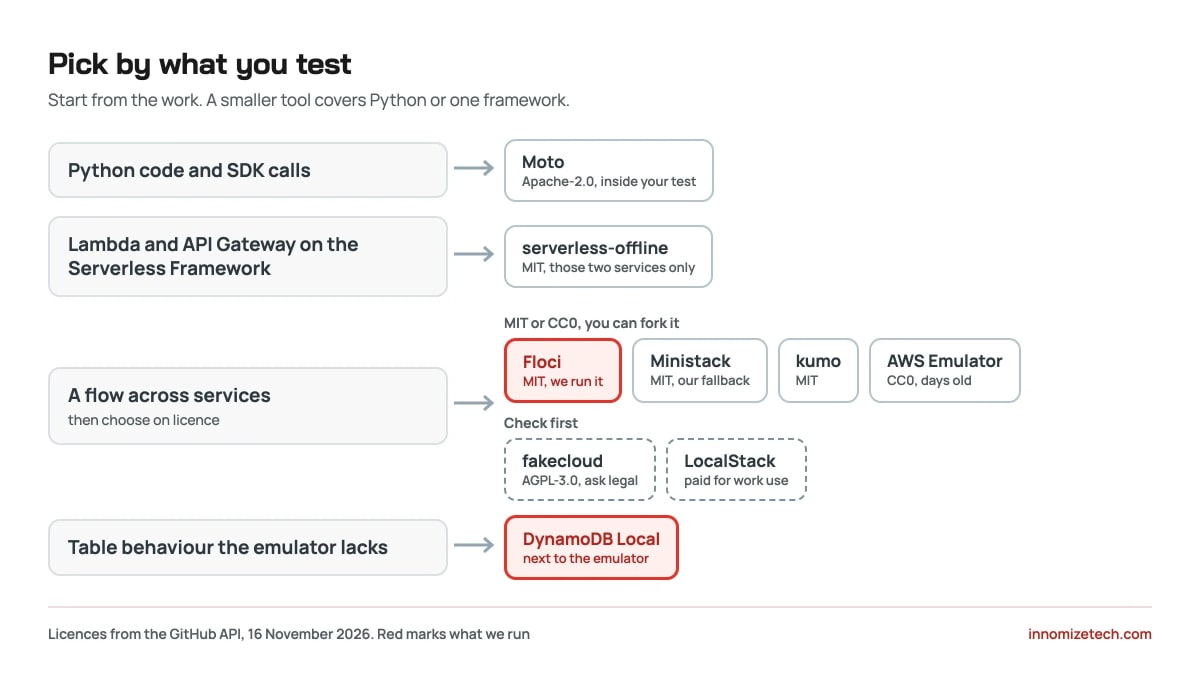
Start from what you need to test. If it is Python code and an SDK call, Moto is enough. If it is a Serverless Framework project with only Lambda and API Gateway, serverless-offline covers it. If it is a flow across services, pick a full emulator and choose on licence, the services you need and how it runs Lambda. For us that meant a licence we could fork, and Floci. AWS Emulator is the one to watch, because it comes from the source of truth, but it is days old and in memory only.
AWS says no human reviewed the code of its emulator. Would you let a test suite built on it block your deploys?