Image Source: McKinsey & Company, "The State of AI in 2025" (2025)
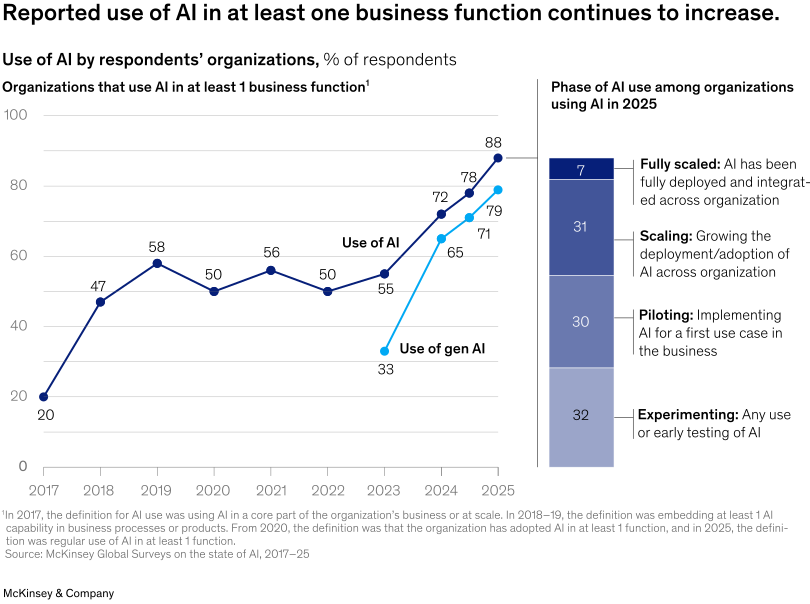
88% of companies used AI in 2025. Only 6% actually won with it.
That single statistic from McKinsey's 2025 State of AI report captures everything about where enterprise AI stood last year. We moved past the adoption question entirely. The harder question emerged: who actually captured value, and why?
We spent time reviewing the major research from McKinsey, Gartner, Stanford's AI Index, and GitHub's developer productivity studies. A clear picture emerged, and it wasn't the story most people expected. 2025 wasn't the year AI transformed business. It was the year we discovered which organizations knew how to make AI work, and which ones were just checking boxes.
Here's what the data revealed, and what it means for 2026.
The adoption-value gap: everyone had AI, few benefited
The headline numbers from 2025 looked impressive on the surface. McKinsey's survey showed 88% of organizations used AI in at least one business function, up from 78% a year prior and just 55% two years before (McKinsey State of AI 2025). Generative AI adoption specifically jumped to 71% of organizations using it regularly, nearly double the rate from early 2024.
But when you dig deeper, the story changes completely.
Only 39% of organizations attributed any financial impact to their AI investments. Among those who did see impact, most reported less than 5% of their EBIT was attributable to AI (McKinsey State of AI 2025). That's not transformation. That's expensive experimentation.
The real divergence happened at the top. McKinsey identified a small group of high performers, just 6% of respondents, who captured disproportionate value through systematic approaches to AI deployment. The remaining 94% used AI but didn't transform with it (McKinsey).
What separated these top performers from everyone else? It wasn't the models they chose or the budget they allocated. The single biggest differentiator McKinsey found was workflow redesign. Out of 25 attributes tested, redesigning workflows around AI had the greatest effect on an organization's ability to see real financial impact.
This finding matches what we observed across engineering teams we've worked with. The companies treating AI as a feature to bolt onto existing processes saw marginal gains at best. The companies willing to rethink how work gets done, questioning which tasks should exist at all, saw compounding returns that widened over time.
There's a simple truth here:
AI doesn't improve bad processes. It accelerates them.
The agent revolution: real, but earlier than expected
If there was one AI trend that dominated 2025 conversations, it was agentic AI. The concept captured executive imagination everywhere: autonomous systems that could plan and execute multi-step workflows without human intervention, handling entire processes from start to finish.
The data justified much of this excitement, but the timeline proved longer than the hype suggested.
Gartner predicted that by 2028, at least 15% of day-to-day work decisions would be made autonomously through agentic AI (Gartner 2025 Predictions). That sounds transformative until you realize that in 2024, that number was essentially 0%. We were standing at the very beginning of something significant, not in the middle of a transformation.
Looking ahead to this year, Gartner forecasts that 40% of enterprise applications will feature task-specific AI agents by end of 2026, up from less than 5% in 2025 (Gartner). That represents 8x growth in a single year. But it also meant that 95% of enterprise apps had no agent capabilities whatsoever when 2025 ended.
McKinsey's data painted a similar picture: 62% of organizations were experimenting with AI agents, but only 23% reported actually scaling an agentic AI system somewhere in their enterprises (McKinsey State of AI 2025). The gap between experimentation and production deployment remained wide throughout the year.
Why did so many experiments fail to reach production? The same reasons that have always separated impressive demos from reliable deployments: reliability, error handling, edge cases, security, and governance. Building an agent that works well in a controlled demo environment is relatively straightforward. Building one that handles the messy reality of enterprise data, integrates gracefully with legacy systems, fails safely, and operates within compliance requirements is genuinely difficult work.
The organizations that scaled agents successfully shared common traits. They had invested in strong data foundations before the agent hype began. They established clear governance frameworks that defined when agents could act autonomously and when human oversight was required. And they maintained realistic expectations about what agents could handle today versus what remained experimental.
2025 separated agent builders from agent shippers. Most organizations ended the year still in the building phase, with production deployment remaining a goal for 2026 and beyond.
AI coding tools: the productivity promise and its complications
Nowhere was the AI productivity debate more heated than in software development. The adoption numbers were staggering. GitHub Copilot reached over 15 million users globally by end of 2025, representing a 4x increase in just one year (Second Talent). 90% of Fortune 100 companies had adopted it (GitHub). Stack Overflow's Developer Survey 2025 found that 88% of professional developers used AI somewhere in their development process (Stack Overflow).
The productivity research seemed to support the hype. A controlled study by researchers from Microsoft, MIT, Princeton, and Wharton found developers using Copilot achieved a 26% increase in productivity, measured by pull requests completed per week (GitHub Blog). Another trial showed developers completing tasks 55.8% faster with AI assistance (arXiv).
But the full story was more complicated than these headline numbers suggested.
The first complication was a ramp-up period that most organizations underestimated. Microsoft's research indicated it takes approximately 11 weeks for developers to fully realize productivity gains from AI coding tools (GitHub Resources). Teams often experienced an initial productivity dip during this adjustment period as developers learned new workflows. Organizations expecting immediate returns grew frustrated and abandoned tools before benefits had time to materialize.
The second complication was that speed wasn't the only metric that mattered. A study from Uplevel Data Labs found developers with Copilot access showed significantly higher bug rates while their issue throughput remained consistent (Visual Studio Magazine). GitClear's research identified "disconcerting trends for maintainability," with code churn projected to double compared to pre-AI baselines (GitClear).
The pattern we observed across teams was consistent:
AI coding tools accelerated output, but output isn't the same as outcomes.
Shipping more code faster provides no benefit if that code creates more bugs, increases technical debt, or solves the wrong problems entirely.
The developers who captured real value from AI tools were those who understood what the AI generated. They reviewed suggestions critically, caught errors before they entered the codebase, and maintained their mental model of the system. Those who accepted suggestions blindly, what some have called "vibe coding," produced working demos but fragile systems that proved expensive to maintain.
The lesson from 2025 is clear: coding isn't dead. Understanding code is more important than ever.
The data foundation problem nobody wanted to discuss
Every AI conversation in 2025 eventually hit the same wall: data. It was the uncomfortable topic that executives preferred to avoid, but it determined outcomes more than any other factor.
Gartner's research revealed that 57% of organizations estimated their data was not AI-ready (Gartner Hype Cycle 2025). This wasn't a technology problem that could be solved with better models. It was an organizational problem that no amount of AI capability improvement could address.
AI models are only as good as the data they're trained on and the data they access at runtime. Organizations with fragmented data systems, inconsistent data quality, unclear data ownership, and inadequate data governance struggled with AI regardless of which models or tools they deployed. The issue was foundational, not technological.
This reality explained why so many AI pilots succeeded in controlled environments but production deployments failed. Pilots operated on carefully curated datasets where the data had been cleaned and structured specifically for the experiment. Production systems faced the full complexity of enterprise data: missing fields, inconsistent formats, stale information, conflicting sources, and access restrictions that nobody had mapped.
The high-performing organizations that captured disproportionate AI value didn't start with AI at all. They started with data (McKinsey State of AI 2025). Years before AI became the dominant business conversation, they had invested in data infrastructure, data quality programs, and data governance frameworks. When the AI opportunity arrived, they were ready to capitalize on it because the foundation was already in place.
For organizations still struggling with basic data challenges, the path forward is not more AI experimentation. It's foundational data work. This isn't glamorous work, and it doesn't generate exciting press releases, but it's necessary work that determines whether future AI investments will succeed or fail.
The ROI reckoning: from investment to accountability
2024 was the year of AI investment. 2025 became the year of AI experimentation. 2026 will be the year of AI transformation, where organizations must finally do the harder work: redesigning workflows, fixing data foundations, and maintaining what they've built. The shift was palpable across industries.
McKinsey's survey showed that 92% of organizations planned to increase their AI budgets over the next three years (McKinsey State of AI 2025). The money continued flowing freely throughout 2025. But by mid-year, boards and executives had started asking harder questions about returns. The easy enthusiasm of early adoption gave way to serious scrutiny.
The conversation shifted from "Are we investing in AI?" to a more pointed question:
"What has AI actually delivered?"
This pressure turned out to be healthy for the industry. It forced organizations to move beyond vanity metrics like models deployed, tools adopted, and pilots launched. Instead, they had to focus on business outcomes: revenue impact, cost reduction, efficiency gains, and quality improvements that could be measured and verified.
The organizations that thrived in this environment were those that had established clear measurement frameworks from the beginning. They could articulate precisely what AI was supposed to achieve, exactly how they would measure success, and what timeline was realistic given the complexity of the implementation. They also distinguished clearly between experimentation, which represented learning investments with uncertain returns, and deployment, which represented operational investments with measurable outcomes.
The organizations that struggled were those who had invested in AI primarily because everyone else was doing so, without clear hypotheses about value creation. When the accountability questions inevitably came, they found themselves with spending to report but no meaningful results to show for it.
What 2025 taught us
Across every data source we reviewed, a consistent picture emerged. The lessons weren't surprising in hindsight, but they contradicted much of the conventional wisdom that dominated AI conversations in 2024.
AI adoption became universal, but that wasn't the interesting part. The question shifted entirely from whether to use AI to how to use it effectively. Universal adoption made the differentiation factors more visible, not less.
Value capture remained highly concentrated. A small group of top performers captured most of the returns while the majority saw minimal impact despite similar investments. The gap between leaders and followers didn't narrow as AI became more accessible. It widened.
Implementation mattered more than technology choice. The winning organizations didn't use different AI models or have access to special capabilities. They used AI differently. They redesigned workflows around AI capabilities. They invested in data foundations before scaling AI usage. They built systematic approaches to deployment rather than pursuing scattered experiments.
The hard work turned out to be organizational, not technical. Model capabilities had outpaced most organizations' ability to absorb them. The constraint on value creation wasn't AI technology at all. It was change management, data readiness, and the willingness to fundamentally redesign how work gets done.
Hype cycles continued, but reality started catching up. Agentic AI proved to be real and promising, but much earlier in its development than the hype suggested. Coding assistants delivered genuine productivity gains, but required sustained investment to realize their potential. The productivity improvements that many expected to be automatic turned out to require deliberate effort.
The organizations that won in 2025 shared a common perspective. They treated AI as an organizational transformation, not merely a technology deployment. They asked harder questions about what work should exist at all, not just how to do existing work faster.
The tools arrived in abundance. The question was whether we were ready to use them effectively.
Most organizations, it turned out, were not.
What this means for 2026
The lessons from 2025 aren't historical curiosities. They represent the playbook for what comes next.
The gap between top performers and the rest will widen. Organizations that invested in data foundations and redesigned workflows during 2025 are now compounding their advantages. Every month of head start translates into capability that competitors will struggle to match. Those still treating AI as a feature to bolt onto existing processes will fall further behind.
2026 is about going deeper.
Deeper on AI-powered development workflows that integrate human judgment with AI capability at the right points. Deeper on foundation-first architecture that enables rather than constrains AI adoption. Deeper on delivering measurable outcomes, not just producing outputs faster.
The experimentation phase that characterized 2024 and early 2025 is effectively over. The execution phase has begun.
From insight to action
The data points to a clear conclusion. The organizations that captured value from AI in 2025 did one thing differently from everyone else: they redesigned workflows before deploying tools.
This isn't a theoretical observation. We've been applying this approach ourselves and documenting what works and what doesn't along the way.
Our framework breaks AI adoption into four sequential steps: workflow mapping, skill development, guardrails, and finally tools. The order matters because each step builds on the foundation laid by the previous one. Skip a step, and the later steps become much harder to execute successfully.
For a practical guide on implementing this approach in your organization, read our full framework: AI Adoption Is a Workflow Decision, Not a Tool Decision.
The gap between top performers and everyone else isn't about technology access or budget. It's about approach. And approach can be learned and improved.
Sources: